

The hunt begins now.
Want me to read this post to you?
There’s also a video with a pretty background, if you’d rather watch and read the subtitles.
Chapter 1: The Robbery
Brussels
The United Kingdom of the Netherlands
September 25, 1829
The Princess of Orange’s carriage sped through the Namur gate, leaving Brussels and its obligations behind. Rather than put in an appearance at her brother-in-law’s party, she preferred to spend the night under the same roof as her children, in her white-columned country villa.
Socializing didn’t come easily to Anna Pavlovna, although she loved the glamorous gowns and dazzling jewels formal occasions required. Once, she had entered the royal box at the theater wearing a tiara that, according to one overwhelmed observer, “displayed a greater profusion of diamonds than perhaps any individual ever beheld upon one person at one time.”1 Her grandmother, Catherine the Great, had also used jewels to convey power and majesty. From the 189.62-carat Orlov diamond in the Imperial Scepter to the 400-carat red spinel topping the Imperial Crown, Catherine had dazzled her Russian subjects with one clear purpose in mind.2 Splendor created awe, and awe inspired respect. If a Russian monarch lost that respect, he could lose his life – as had Anna’s father and grandfather, both murdered in palace revolutions. It was a lesson she had absorbed to the very marrow of her bones.
If a Russian monarch lost that respect, he could lose his life – as had Anna’s father and grandfather, both murdered in palace revolutions.
When Anna arrived at Tervuren, two and a half leagues from Brussels, her chambermaid, Natalia Petrovna Chernysheva, helped her get ready for bed. For thirteen years, Natalia had been a trusted companion who reminded her of home. It was Natalia who cleaned and cared for all her jewels, preserving the links they represented to the people she loved. Many had been wedding presents from her husband, Prince Willem of Orange, and her brother, Emperor Alexander I. Every year on her birthday and name day, her mother sent more. One year, it was a pair of bracelets set with gleaming topaz, her favorite stone. Another year, it was a tiara set with turquoise, a stone that symbolized a happy marriage.
Wearing these gifts made Anna feel closer to her family, despite being over 1,500 miles from St. Petersburg. As a young bride, she had once thought she was being criticized for wearing too many jewels. When she asked her mother for advice, Dowager Empress Maria Feodorovna reassured Anna that her position required her to dress the part. With her mother’s blessing, Anna continued to wear her diamond butterfly, her chain of Siberian amethysts, and the pearls said to have belonged to Marie Antoinette.3
Recently, Anna had worn her perfectly matched drop pearl earrings with an off-the-shoulder blue velvet gown to sit for a portrait by Jean Baptiste van der Hulst.4 Hairstyles of the time were not small, featuring sections of hair curled and looped across the head. As fashionable as it was, Anna’s coiffure couldn’t compete with her tiara: a large diamond kokoshnik in a foliate scroll design, topped with a row of circular brilliants and large diamond drops. Part of her Russian trousseau, it symbolized her wealth, origin, and position. But by the time Van der Hulst delivered the completed painting, her tiara had vanished. Its real-life luster had been reduced to a memory, just a few dots of white paint pressed into canvas. She would never see it again.
*
A few hours after Anna went to bed, a workman walked the well-worn path outside the Brussels city wall. Despite the pre-dawn darkness, he saw a ladder propped against the wall near the Leuven gate. He walked over to inspect it and saw something else on the ground nearby: a woman’s shawl, soft and luxurious. Before anyone could see what he’d done, the workman hurried away with the shawl. Later that night, over a beer, he would tell his friends at the estaminet about his good luck.5
*
An hour or so later, inside the city, another workman left home before sunrise. Étienne Parfait made his way down Rue de la Madeleine, across the Place Royale, and past the king’s palace to that of his son and heir, Prince Willem of Orange. Even in the dim morning light, the palace was imposing. Its austere neoclassical design featured a long row of columns and pilasters facing the public park. Built with three shades of Arquennes blue stone, it was one of the few buildings in the city not plastered or painted. The opulent interior featured a grand marble staircase, Corinthian columns, golden candelabra, and furniture from the Princess of Orange’s dowry, crafted with lapis lazuli, malachite, and other precious materials. The glittering treasures of the princess’s trousseau complemented the prince’s art collection, including paintings by Van Eyck, Memling, and Rembrandt. When no one was home, palace caretakers admitted visitors to gawk at the royal couple’s art and objects. They handed out shoe covers to protect the floor and told visitors to slide, as if on skates, to avoid a fall.6
When no one was home, palace caretakers admitted visitors to gawk at the royal couple’s art and objects. They handed out shoe covers to protect the floor and told visitors to slide, as if on skates, to avoid a fall.
No tourists were present that Saturday morning when Parfait climbed the palace stairs to clean the princess’s bedroom. But someone had been there before him – someone who should never have been there at all. The princess’s jewelry chest stood against a wall near the fireplace, like it always had, but the upper cabinet was no longer surrounded by thick plate glass. Someone had shattered it, then flung open the doors of the lower cabinet.
Parfait ran to tell the concierge, Nicolas Cavanillas. An elderly Spanish man, Cavanillas had worked for Prince Willem of Orange for years and was responsible for the second floor of the palace. One glance at Anna’s bedroom convinced Cavanillas the situation was grave, too much for him to handle on his own. He left the palace and hurried to the home of Anna’s secretary, arriving at 524 Rue de l’Abricot between 8 and 9 a.m.7
One glance at Anna’s bedroom convinced Cavanillas the situation was grave, too much for him to handle on his own.
Born in St. Petersburg in 1793, Karl Ivanovich Schultz had come with Anna to the Netherlands upon her marriage. He worked as her private secretary and held a commission in the Russian Ministry of Foreign Affairs. But he and his English wife weren’t expecting company that morning. Confused, Schultz asked Cavanillas if he’d come to announce Anna’s arrival. Perhaps she had come back early from Tervuren and needed him? The look on the older man’s face told Schultz it was something else. With a glance up the street, aware of prying eyes, he took Cavanillas upstairs.8 There, the Spaniard told Schultz what had happened: someone had stolen the Princess of Orange’s jewels.
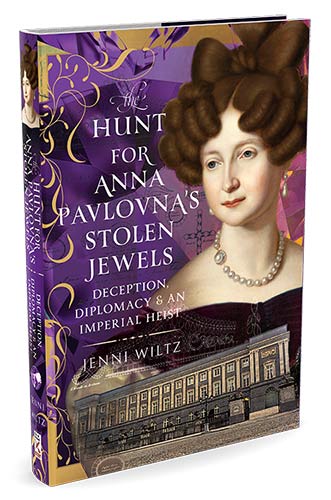
The Hunt for Anna Pavlovna’s Stolen Jewels
Published by Pen & Sword History (2026)
Available in hardback and eBook
Notes
- “The King,” London Chronicle, October 8, 1821, British Newspaper Archive. ↩︎
- Stefano Papi, The Jewels of the Romanovs: Family & Court, revised and expanded ed. (New York: Thames & Hudson, 2013), pp. 36-38. ↩︎
- For mother’s advice: Sydney W. Jackman, ed., Chère Annette (Stroud, Gloucestershire, UK: Alan Sutton Publishing, Inc., 1994), pp. 132-3. For jewels: Pieter Nicolaas Arntzenius, ed., Procès de Constant Polari, vol. 1 (La Haye: Chez Th. Lejeune, 1835), chap. 1, doc. 2, pp. 7-11. For origin of pearls: Lady Walburga Paget, Scenes and Memories (New York: Charles Scribner’s Sons, 1912), 42. ↩︎
- “Portret van Anna Paulowna,” Koninklijke Verzamelingen, accessed August 4, 2024, https://www.koninklijkeverzamelingen.nl/collectie/portret-van-anna-paulowna-7482. ↩︎
- See Stoop and Van Maanen’s reports in: Arntzenius, ed., Procès, vol. 1, chap. 1, docs. 3-4, pp. 18, 23-24. ↩︎
- For Parfait’s Brussels address and arrival time at work: Arntzenius, ed., Procès, vol. 1, chap. 1, doc. 1, 1. Palace details: Francis Strauven, “Le Palais des Académies – une résidence urbaine offerte au Prince d’Orange par les Belges,” Revue belge de philologie et d’histoire 94, no. 2 (2016): pp. 416-19. Artwork: C.J. Nieuwenhuys, Description de La Collection Des Tableaux Qui Ornent Le Palais de S.A.R. Mgr. Le Prince d’Orange a Bruxelles (Brussels: Alex. De Mat, 1837), pp. 1, 6-16, 46, 50. Tourists admitted: Jacobus Noorduyn, Herinneringen van een uitstapje naar Brussel in Augustus 1836 (Gorinchem, Netherlands: Jacobus Noorduyn, 1836), 37. ↩︎
- Location of the chest: Pieter Nicolaas Arntzenius, ed., Procès de Constant Polari, vol. 2 (La Haye: Chez Th. Lejeune, 1835). The end paper contains a drawing of the layout of Anna’s bedroom. Cavanillas’s responsibility: Dorine Hermans and Daniela Hooghiemstra, eds., “Voor de Troon Wordt Men Niet Ongestraft Geboren”: Ooggetuigen van de Koningen van Nederland, 1813-1890 (Amsterdam: Bakker, 2008), 137. Arrival at Schultz’s home: Arntzenius, ed., Procès, vol. 2, 496. ↩︎
- Schultz’s position: Arntzenius, ed., Procès, vol. 2, 496. Exchange with Cavanillas: Arntzenius, ed., Procès, vol. 2, 496. ↩︎
About the Author

Want More?
Join my mailing list and get a free PDF with four tiara stories.
Plus get occasional news from me, including royal history discoveries, and Grand Duchess Louise of Baden’s meatloaf recipe. I kid you not. It includes bacon, if that helps.
Join NowAdditional Credits
- Header image, Anna and palace: public domain via Wikimedia Commons.
- Background music in audio post licensed via Envato Elements.